Yarmouk, Syria, was originally a temporary refugee camp for thousands of Palestinians displaced by the 1948 Nakba; however, the camp eventually grew to a lively metropolis with a vibrant community of artists, intellectuals, and families. Home to an estimated one million residents, Palestinians and Syrians lived together in Yarmouk under the authoritarian regime of the notorious Assad family. During the protracted civil war in Syria, Yarmouk became the site of repeated bombardment by heavy artillery and intense sieges. Fleeing war, illness, and starvation, hundreds of thousands left Yarmouk; yet, a handful of residents remained, determined to fight against tyranny.
In December 2024, the Assad regime finally fell. Now, residents of war-torn Yarmouk are returning to rebuild their homes and their lives once again. For this on-the-ground documentary report, TRNN was granted access to the camp and spoke to residents about what life was like in Yarmouk during the many violent years before the fall of Assad’s regime—and about what life in Yarmouk can be now.
VO:
This is not Gaza.
This is Yarmouk, a refugee camp in Damascus in Syria.
First established in 1957 to house those forced out of Palestine during the Nakba, when Zionist militia violently expelled and murdered Palestinians and occupied their homes.
Yarmouk began as a temporary refugee camp and evolved into a vibrant community of exiled families.
It became the capital of the Palestinian diaspora.
Khaldoun Abdel Rahman Al Malah:
In Yarmouk, every street, school, clinic, and bakery in the camp carries the name “Palestine”.
VO:
When the Syrian civil war erupted in 2011, residents of Yarmouk were faced with abandoning their homes once more.
Character:
People should fix their homes and return here. Life must return to the camp.
VO:
We spoke with people who remained, even under siege, to dutifully defend their communities.
Etaf Nusrat Abood Al-Hawari:
All my brothers and sisters died of illnesses, there was no medicine, no food, no bread.
VO:
And to those who are now returning as the war is finally over, to the homes they were forced to flee.
Mohamed Al Freij:
[Returning] was the best feeling ever.
We hugged.
Tears of joy ran from our eyes.
Tears of grief.
What more can I say?
It was the greatest feeling of my life when I entered Yarmouk.
VO:
Since the fall of the authoritarian regime of Bashar al Assad in December 2024, Syria has been in a state of celebration and uncertainty.
[gunfire]
Etaf Nusrat Abood Al-Hawari:
Get up!
Hay’a, Hay’a, Hay’a (HTS).
VO:
A coalition of rebel forces under the banner of Hyatt Tahrir A-Sham, or HTS, now rules the country.
Thousands of people are returning to their homes.
Khaldoun Abdel Rahman Al Malah:
It’s our capital in the diaspora. Destroying this capital,
along with the symbolism it bears, could be regarded as a favor from Assad’s regime to the Zionist enemy.
VO:
Yarmouk was a strategic point during the uprising against the Assad regime, and civilians here had to choose between fight or flight.
Ahmad Shehada:
We grew up in the camp, knowing it was little Palestine.
I can’t describe how beautiful the camp was.
It’s the connection and the gateway to our homeland.
Title on a sign:
‘Camp Palestine’
Diaa Amouri:
People didn’t need to go to Damascus for anything.
The camp was like a city of its own.
Mohamed Al Freij:
It was the strongest area economically and socially.
It was home to many students and doctors.
VO:
Yarmouk was once a thriving hub of intellectual life, shaped by a people whose identity was rooted in resistance, even as the state they took refuge in continued to repress them.
Ahmad Shehada:
The camp is an emotional and revolutionary idea.
VO:
Life in Yarmouk also meant facing the dangers of resisting the regime.
Secret police listened to conversations, and Syrians and Palestinians alike saw decades of brutal, state-sanctioned killings, kidnappings, and torture.
Mohamed Al Freij:
We feared speaking out, because the walls had ears.
We lived in terror and fear.
VO:
In 2011, emboldened by the effects of the Arab Spring in neighbouring countries, civil unrest erupted into protests against the five-decade-long rule of the Assad family.
Ahmad Shehada:
The thing I remember that makes me laugh was the first moment of our participation in the Syrian revolution, in Yarmouk.
At that moment, we felt like it was the first time my generation
exercised their revolutionary right.
I met some guys during the Syrian Revolution, we discussed our role as Palestinians in what was going on.
Positive neutrality was proposed.
VO:
As government forces brutally cracked down on the protests, violence escalated across Syria, and the camp became refuge for activists fleeing regime persecution around Damascus.
Ahmad Shehada:
By the outbreak of the Syrian revolution it was almost the 65th anniversary
of the Palestinian Nakba.
Victims would stand side by side with victims.
Abu Jihad Khattab:
Here you are.
Peace be upon you.
Interviewer:
Can you say your name please?
Abu Jihad Khattab:
Abu Jihad Khattab.
Palestinian-Syrian born in Yarmouk.
The blood of Syrians and Palestinians has mixed with that of thousands of martyrs.
[Former Israeli President] Sharon said, “You will have your day, Yarmouk.”
Assad’s regime made his dream come true.
VO:
It wasn’t long before regime forces opened fire on demonstrations inside the camp and residents of Yarmouk were placed at the centre of the uprising.
Ahmad Shehada:
It was revealed later that the regime couldn’t secure southern Damascus
without locking down Yarmouk.
VO:
Yarmouk was seen as a strategic entry point for rebels advancing on Damascus, and it bore the cost with relentless sieges and deadly battles.
Abu Jihad Khattab:
Those were the most difficult years of our lives.
We were in the prime of our youth.
We sacrificed it for the sake of God.
It was very difficult to lose close friends and siblings.
Those were harsh unforgettable moments.
The last person we buried was my big brother, Shadi.
Yussif Mohammed Sharqawi:
I have painful memories from Yarmouk.
The most violent was the first airstrike that hit the camp in Al Ja’ouni street in August 2012, during Ramadan, before the airstrike on
Abdel Qadir Al Husseini Mosque.
The missile fell half an hour before breaking fast, more or less.
And we learned the strategy of launching missiles: the first missile hits somewhere, you go to rescue the wounded or retrieve bodies, the second missile hits the same place again in order to target the largest possible number of people.
It makes you lose control when you see people you’ve known for years subjected to this kind of death.
The first time you see incomplete bodies, not normal bodies, bodies torn apart by shells.
It was the first sign of what Yarmouk would face in the coming years.
Um Nayef:
I left when the warplane struck the mosque.
I took my children.
I feared for their lives.
Yussif Mohammed Sharqawi:
In other words, the second Nakba was when
we left the camp on December 19, 2012.
It was an atmosphere filled with pain and distortion.
Thousands of people gathered on the main road and stood side by side.
Some of them were carrying toddlers.
Some were holding backpacks, not knowing what to take.
They were leaving.
VO:
Assad’s forces and armed groups affiliated with various foreign powers, including Israel and the US, were at war with Yarmouk.
The Little Palestine was the embodiment of resistance.
Abu Jihad Khattab:
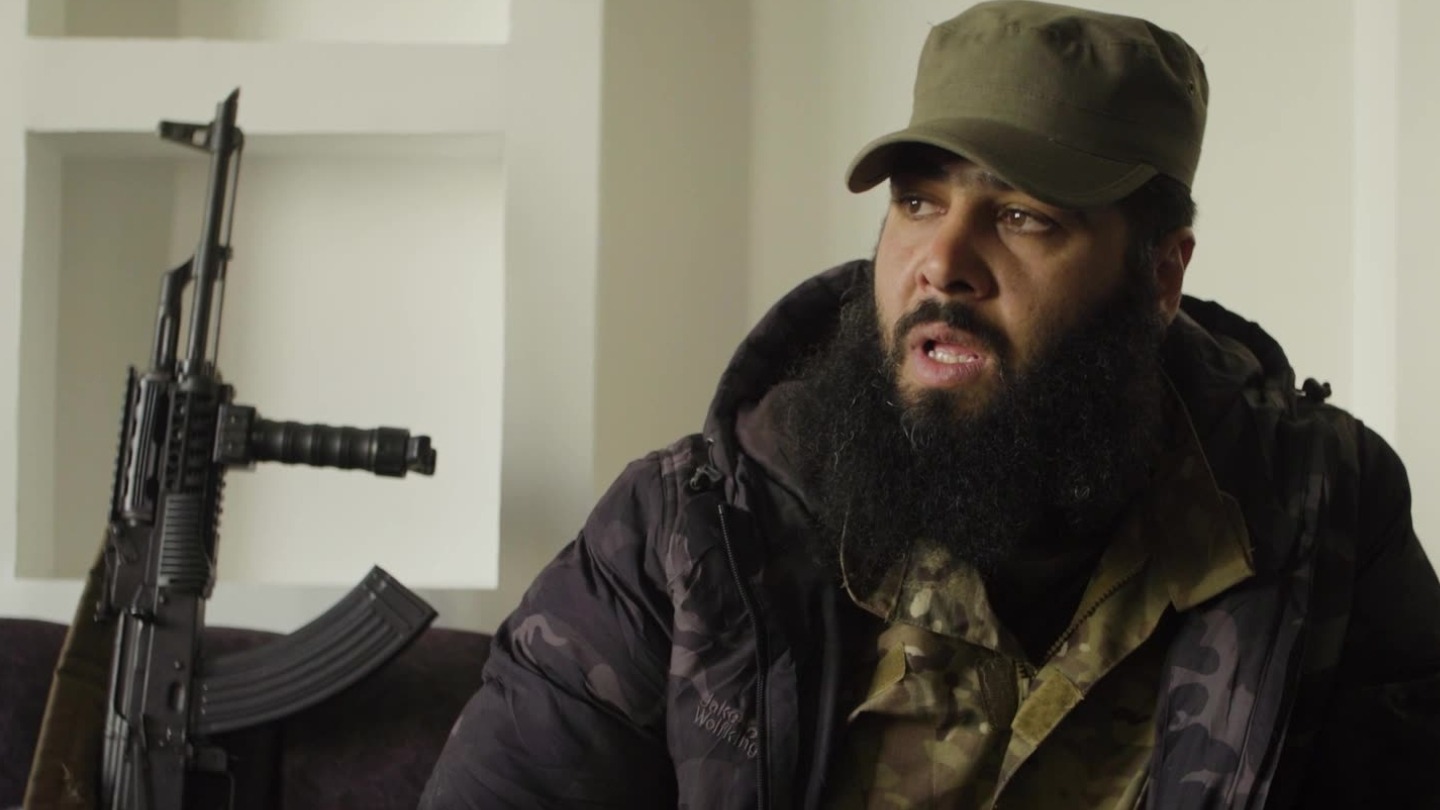
I chose to defect [from the regime army] and join the Syrian revolution.
I was deployed inside the camp.
Another Abu Jihad:
Those who remained in Yarmouk participated in various kinds of work.
Some of them took up arms.
I also took up arms.
Room by room battles -you’d be in one room and your
enemy would be in the next.
VO:
In the face of violence, the community united, building networks of solidarity and resistance to defend the camp.
Amal Asfour:
I’m Amal Asfour, aid activist member of the Popular Front
for the Liberation of Palestine (PFLP).
PFLP had a role in founding a national body to aid
Palestinians in Yarmouk.
This organization was a real national achievement that lessened the suffering of those who remained inside Yarmouk and resisted the blockade, starvation, and poverty.
The second Abu Jihad:
The camp was surrounded from all sides in 2015. There were battles in all areas of the camp.
Assad’s regime and its thugs on one hand,
Iranian thugs on the other, and ISIS on another.
VO:
The camp’s population dwindled from an estimated 1 million to just 18,000 in the course of just a few years.
A handful of brave residents remained, determined to survive and to hold on to their homes.
Etaf Nusrat Abood Al-Hawari:
I was born in Palestine in 1946.
VO:
Etaf Nusrat fled the Nakba in Palestine and arrived in Syria as a refugee.
Someone speaking to Etaf Nusrat Abood Al-Hawari:
You are still youthful.
Yes.
You said you’re 24.
[Etaf Nusrat laughs]
Etaf Nusrat Abood Al-Hawari:
My dad bought a piece of land in the camp, and we have been here ever since.
Etaf Nusrat talking to someone:
This is my father.
Look how handsome he was!
May he rest in peace.
VO:
As tens of thousands fled the siege, she stayed behind. HTS fighters held the line for those still inside.
Etaf Nusrat Abood Al-Hawari:
We were besieged with some HTS members.
They [the regime] asked us to leave aiming to kill them.
We refused.
They threatened that we would die with them from hunger.
War planes roared overhead and tanks stood at the only entrance.
Artillery fell down on us.
We sat in the kitchen, which was safer, because there were several floors above us.
I had a phone case for keeping my mobile.
I asked my brother to put our IDs in the purse and hang it on the kitchen door so that we could be identified if we died.
Can you believe it?
Khaldoun Abdel Rahman Al Malah:
After the large displacement from the camp [in December 2012] 15,000 people remained.
Those 15,000 gradually decreased.
I was the only doctor in the camp for at least three and a half years.
I set up a clinic in the backyard of my house
Or what had once been my house.
I wasn’t alone: there was a large number of youth volunteers.
I documented 188 people, murdered by starvation.
The most difficult time was when the residents complained about a very bad smell that came from one house.
When we opened the door of that house we found the father, the mother their three or four children, all dead while rats were eating their bodies.
They died from starvation in silence.
Rats ate their bodies.
Etaf Nusrat Abood Al-Hawari:
We starved.
We ate rotten food, and slices of bread.
We lost weight. Those who weighed 100 kg were down to 40 kg.
Many, many people died in the camp.
Abu Jihad Khattab:
It was a time of painful memories and a harsh blockade.
We were deeply moved by children, women, and elderly people who died of hunger while we couldn’t do anything for them.
But as fighters, we stood on the front lines.
We were determined either to live with dignity or to die.
Khaldoun Abdel Rahman Al Malah:
There was an individual called Abu Said who in the midst of the blockade and destruction, and at the height of ISIS’s control, I always saw him in a suit and tie, with a shaved beard.
He wore aftershave.
Abu Said:
We ate herbs that grew along the streets.
We prepared it as a salad.
Why? Because there was no bread.
Khaldoun Abdel Rahman Al Malah:
He was walking in Al Yarmouk Street, smiling.
I greeted him every day I saw him.
He was both hungry and ill, yet he was always positive.
He gave me strength.
Abu Said:
Welcome.
VO:
Khaldoon, like many returning to Yarmouk to rebuild their lives, is reuniting with people he thought he’d never see again.
This man hasn’t seen his father for 12 years.
In Yarmouk, generations of displaced people remain committed to protecting and rebuilding their communities, and now they return (once again) in an act of defiance.
Yussif Mohammed Sharqawi:
When so many people are gathered here together 14 years after everything we went through it’s like a revenge.
Returning here is a revenge against our departure.
Closing title card:
It’s estimated that over 650,000 people died in the Syrian civil war.

Source link