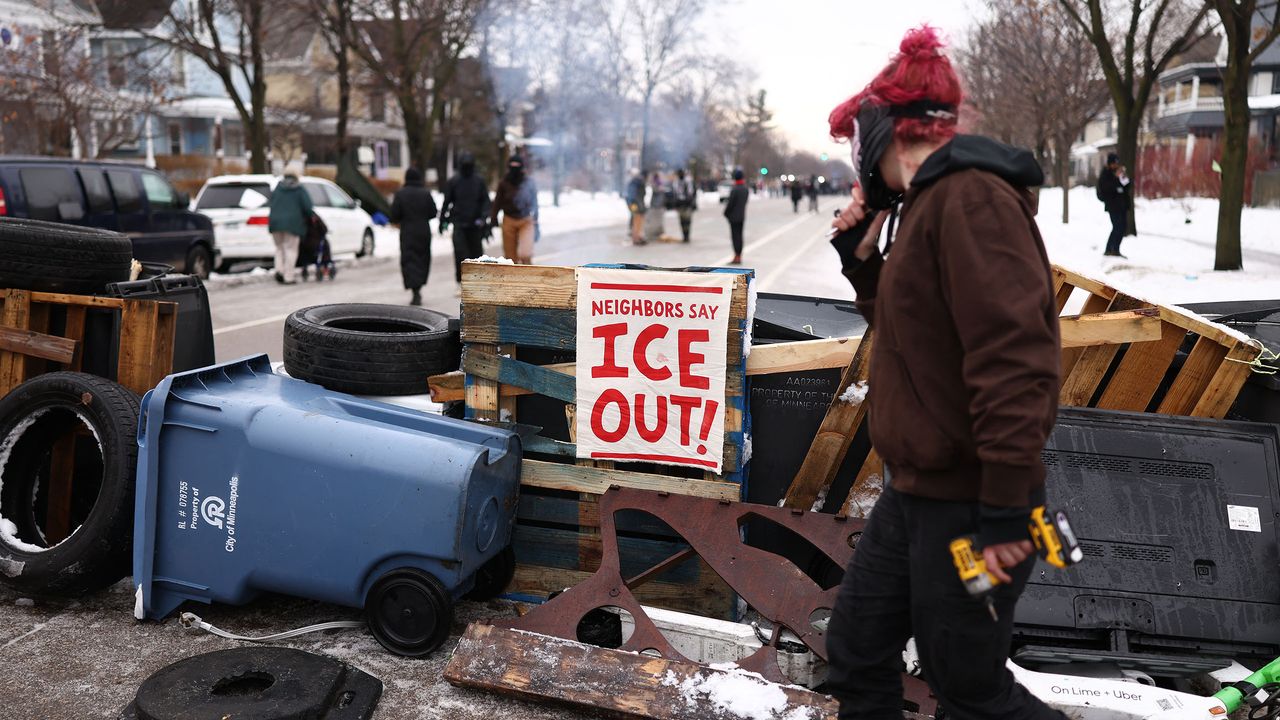
Five years ago, a Minneapolis police officer, Derek Chauvin, killed a man named George Floyd. The Twin Cities, then the rest of the country, exploded in Black Lives Matter protests: daily marches, traffic blockades, calls to defund the police, and public destruction that matched the turmoil so many Americans were experiencing. In response to the burning of a police precinct, the governor of Minnesota, Tim Walz, called up more than seven thousand National Guard troops and airmen to enforce a curfew. For protestors, there was a blurring of the local and federal; all officers inspired fear.
One arm of the federal government, though, was later welcomed. In 2021, the Civil Rights Division of the U.S. Department of Justice—the standard-bearer in anti-discrimination enforcement—opened a “pattern and practice” investigation into the use of force by the Minneapolis Police Department. Before Floyd, there had been other victims whose names weren’t shouted in the streets.
The Justice Department found that the M.P.D. had used excessive force, especially against protesters, Black people, Native Americans, and people with disabilities. Minneapolis has since banned choke holds and no-knock warrants. The current police chief, Brian O’Hara, has a reputation for fair-mindedness. Problems with local law enforcement persisted, but officers knew that they were being watched—by the people and by the federal government.
For the past few months, federal officials have again been all over Minneapolis. As part of the Trump Administration’s mission to detain and deport a historic number of immigrants, more than two thousand officers with the Department of Homeland Security have swarmed Minnesota’s Twin Cities—St. Paul and Minneapolis, both sanctuary jurisdictions—and their suburbs. Masked, uniformed personnel from Immigration and Customs Enforcement, Border Patrol, and D.H.S. police have arrested hundreds of non-citizens at bus stops, homes, even a library. Agents have asked neighbors to become informants. In subzero temperatures last month, D.H.S. engaged in an hours-long standoff with two men who were atop a partially constructed suburban roof. (ICE said that the men fled from a car “to evade arrest.”)
These operations have targeted Latino and, notably, Somali communities. Minnesota, which has a long Lutheran-inspired history of refugee resettlement, is home to more than a hundred thousand people of Somali descent, nearly all of whom are U.S. citizens. Recently, Trump referred to Somali people, including Ilhan Omar, who represents Minnesota in the U.S. House of Representatives, as “garbage.” The Administration has leveraged a series of social-services fraud schemes, allegedly perpetrated by some Somalis (among others) in Minnesota, as a reason to go “DOOR TO DOOR.”
Earlier this week, Kristi Noem, the Secretary of Homeland Security, joined her agents in Minneapolis. She later posted video of the ride-along: she wears a tactical vest and strides past an armored vehicle, in a file of men outfitted for war, up the stairs of an apartment building. They surround and apprehend an unarmed man whom they describe, on X, as an “Ecuadorian illegal alien convicted of robbery and WANTED for MURDER and SEXUAL ASSAULT.” The next day, an ICE officer, identified in press reports as Jonathan Ross, shot and killed Renee Nicole Good—a white U.S. citizen, poet, and mother of three—in the same area of South Minneapolis where Floyd was murdered. Good was at the wheel of her S.U.V., on a snowy street of large houses and evergreen trees, where ICE was conducting a raid. (It’s unclear whether Good was there as an activist, with a local rapid-response network, or just passing through.) Bystander videos showed an officer grabbing at the door of Good’s vehicle, then Good trying to steer away. Ross walked toward her windshield and shot her multiple times. Trump and Noem have justified his actions as self-defense. The Vice-President, J. D. Vance, accused Good of “trying to ram this guy with her car.” The way the media was reporting the story was an “absolute disgrace,” he added.
I went to a vigil for Good that night. What looked to be a few thousand people crowded into the neighborhood where she was killed. The ground was slushy with snow. One of the speakers, standing near a ring of tea candles and flowers, condemned Good’s death as a “modern-day lynching.” She blamed Trump for sending outsiders—ICE officers—“into our city, where we live, to criminalize us.” A community organizer who went by S.B. told me, “The fear has been daily since ICE has been in the streets.”
