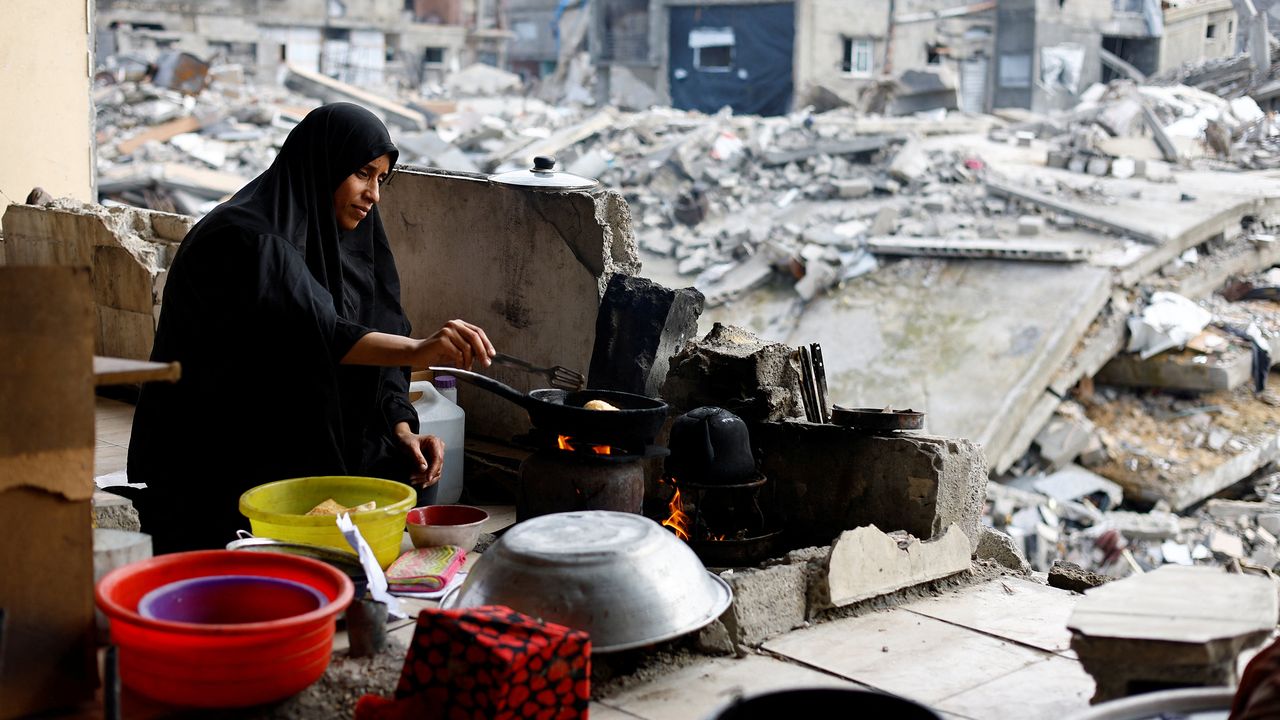
The Gaza Strip is more or less divided between the half controlled by Hamas and the half that is controlled by the Israelis. How has this changed what life is like for Gazans?
In terms of the half of the Strip that is controlled by Israel, they’re not allowing anybody in, and anybody who comes close to what they call the yellow line may get shot or killed. So all Gazans are living inside the Hamas-controlled side, and that’s not enabling us to access our farmland, for example, or garbage-dump sites. There are also cities on the other side, even though they have been largely demolished. Factories and industrial areas are also on that side. There were several wastewater-treatment plants, too. It’s an essential part of Gaza, which is so small. It’s really causing a difficult situation.
Is one of your concerns that this is going to become a long-term border, and that the Gaza Strip and the people who live in it are going to be permanently stuck in the part of Gaza that they’re in now?
No. I think that we have a ceasefire agreement. We have a Trump plan, and we are sure, or hopeful, that the Trump plan will work and President Trump will be able to, if not convince, then force the Israelis to stick to the plan and withdraw from the Gaza Strip.
This is your hope, you’re saying?
It’s hope, and really we believe that it will most likely happen.
Is there a reason that you’re more hopeful about this than I am?
[Laughs.] Because I want to believe it. It’s our only hope. The situation cannot really continue like this.
How would you describe the attitude toward Hamas in the Gaza Strip now?
In what sense? They are controlling everything in Gaza. They are trying to help the situation in Gaza. They are providing security for us, which is most important. You cannot leave things in a vacuum. If you leave New York in a vacuum, without security, without police, what will happen? Same thing in Gaza. So we’re very comfortable with their keeping the security in Gaza. For instance, before the signing of the ceasefire agreement, there was lots of looting of humanitarian aid, and these looters were backed up. They were militias backed up by Israel and protected by Israel. The main one was the Abu Shabab group. They used to loot trucks, and then take refuge in Israeli-controlled areas. That has stopped. It stopped because the de-facto government is preventing them from doing it.
I know that a lot of prominent businesspeople, including you, decided to write a letter to Trump urging an end to the war, right before the ceasefire came into effect. Some of the people who signed that letter were very critical of Hamas in other venues. Was there a division about how much to be critical in the letter?
Anybody in Gaza can be critical of Hamas. It’s O.K. We have freedom to talk about Hamas or anybody else. [Palestinians in Gaza, including journalists, have been physically assaulted for criticizing or reporting negatively on Hamas. Since the ceasefire went into effect, Hamas has also carried out executions of people whom it claims were political rivals or collaborators with Israel.] I mean, it’s a personal opinion, so there’s no problem with that. Is that your question? Maybe I did not understand your question.
Well, I know you’ve said that you think the Palestinian Authority will be better able to bring about a long-term solution and a two-state solution, which you advocate.
Well, it’s our only hope, actually. We want to be united with the West Bank, and the Palestinian Authority is the best scenario for this. We hope we will have elections. I mean, Palestinians deserve to decide, and to have elections—they deserve to select their representatives and to have an exchange of authority.
Right, because the last elections in Gaza were a couple of decades ago, correct?
Exactly. Yes.
Can you talk a little bit about what your job is?
I’m the chairman of the Gaza Chamber of Commerce, Industry, and Agriculture. We are trying here to help our members get their papers for reactivating bank accounts, or to start businesses both outside and within Gaza. We’re trying to help them organize local markets, and coördinate or actually do some networking for them with humanitarian actors. And we do trainings. But there isn’t much we can do, because of Israeli restrictions. They are even preventing some fuel for the private sector. They are preventing the entry of agricultural seeds like tomato, cucumber, whatever, with the intention to keep all people dependent on humanitarian aid and not to be productive. So my job is really difficult, because there isn’t much I can do, but we’re trying to promote, for example, electronic payments, because all the banknotes in Gaza, the cash, is getting worn out and Israel won’t allow us to replace these banknotes.
So we do lots of advocacy work. We collect information about local markets, about some economic indicators. We produce reports in that regard. We make the international community and humanitarian actors aware of the situation, so they can be informed when making plans. We are also doing some really small projects, trying to help people in the food-production sector start or improve their businesses, but we are making very limited interventions because of the lack of finance and production-input materials.
A lot of people in your position or somewhat similar positions managed to leave Gaza during the war. You did not. Can you talk about why you stayed?
Yes. When the war started, I was new in my position: I was elected at the beginning of 2023, and nine months later the war broke out. I felt that I was obliged to stay with the people who elected me in Gaza. I really like Gaza so much, and I don’t think I can stay out of Gaza for long. And what am I going to do outside? Being a Palestinian, it is very difficult to be somewhere outside. And I know many people are in Egypt now, but they are in difficult situations economically. I didn’t think that it would go on this long, of course. But I’m very happy that I did not leave because being outside Gaza for such a long time is not an easy thing.
I know that the humanitarian situation is still not great. I know that people are still dying. I’m just curious what it feels like in the Strip, and if people have become more hopeful or not in the last couple of months since the ceasefire.
