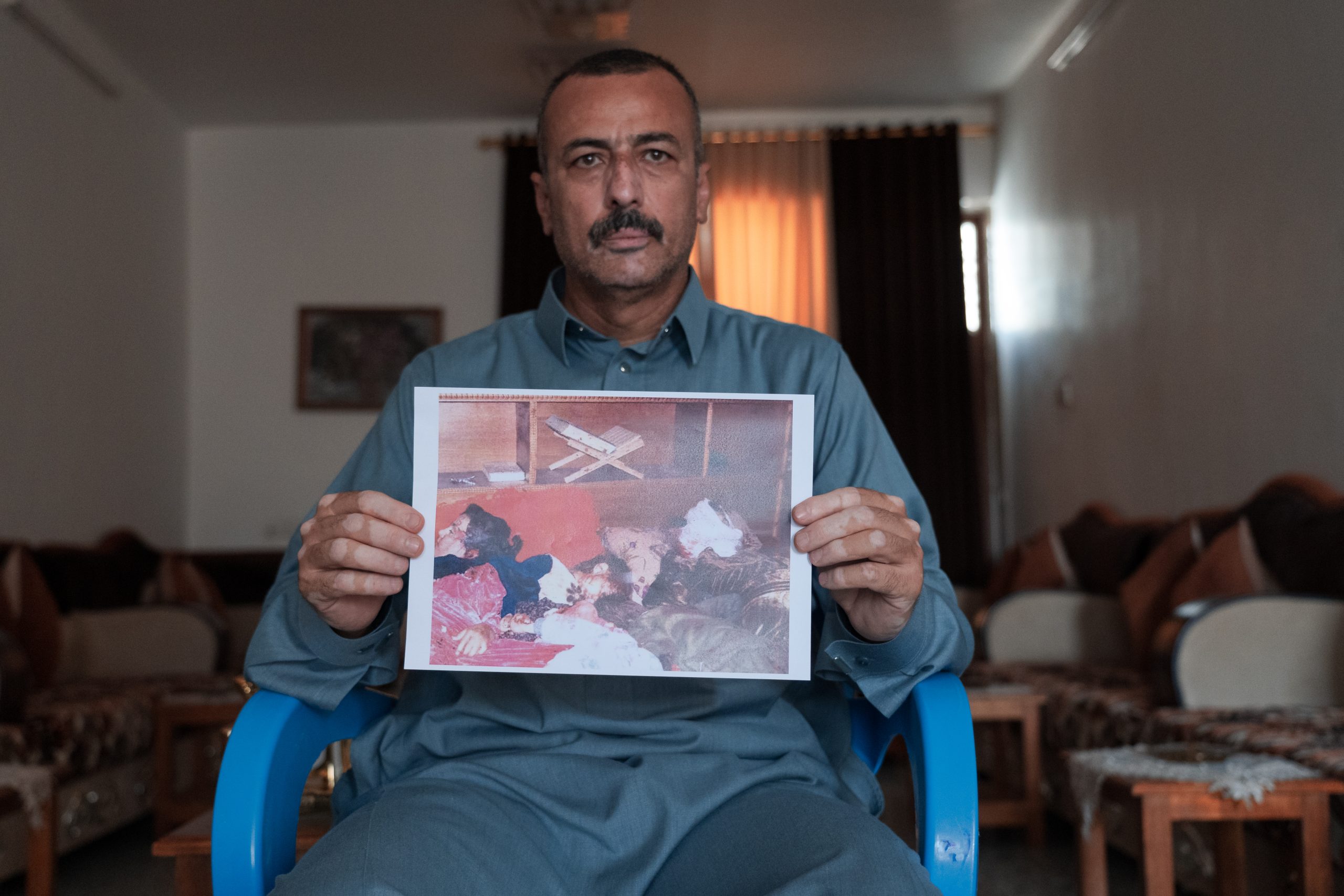
Content material ultimatum: The video incorporated on this thread accommodates graphic photos of sufferers of the Haditha bloodbath.
Khaled Salman Raseef recalls being jolted wide awake via a noisy explosion related his house at the morning of November 19, 2005—precisely twenty years in the past these days.
In Haditha, a once-peaceful Iraqi town alongside the Euphrates River, such sounds had turn into regimen. The close-knit neighborhoods have been reworked right into a struggle zone then the U.S. invasion and the autumn of Saddam Hussein greater than two years previous. Rebel teams, together with Al Qaeda, had taken root right here to struggle American forces.

By means of next, Raseef and his neighbors had a regimen for when an improvised explosive instrument (IED) exploded and U.S. raids adopted. They concealed the aged, ladies, and youngsters in a again room, day the boys opened the doorways and attempted to talk frivolously. No matter came about—whether or not troops in with attack rifles raised or smashed furnishings—the guideline was once all the time the similar: keep well mannered, Raseef says, talking in his house in Haditha.
“Usually, about an hour after an explosion, everything goes back to normal,” the 51-year-old attorney explains. “But that day was unlike any other.”


Bursts of M16 hearth cracked during the morning wind, adopted via a grenade break out—next extra gunfire. Snipers took positions on rooftops; ladies screamed within sight. Without a cellphones or web, citizens had incorrect method of understanding what was once going down, Raseef remembers.
For hours, the sounds got here in waves—gunfire, a unmarried shot, an explosion—each and every adopted via an eerie quiet.
By means of afternoon, citizens emerged waving white flags, absconding the group. What Raseef next discovered modified his occasion without end. Inside of the ones few hours, U.S. Marines had killed 25 unarmed civilians, together with 4 ladies and 6 youngsters. Maximum had been shot at shut space of their properties. Fifteen had been from Raseef’s personal people.
“After that day, we feared the Americans more than Al Qaeda. They were monsters for what they did.”
The incident ended in probably the most high-profile struggle crimes instances in trendy U.S. army historical past. But twenty years after, no person has been held answerable for one of the crucial Iraq Battle’s maximum egregious civilian massacres. However the atrocity residue an unhidden wound for individuals who survived.
“There isn’t a day I wake up and don’t think about what happened,” Raseef says quietly. “It’s become a part of me. It lives with me every day.”
Assassinated via sovereignty
Raseef guides me thru Haditha’s streets, week multi-story stone properties that experience witnessed generations of occasion—and the unexpected intrusion of demise. Some partitions nonetheless undergo embedded bullets.
“This is my cousin’s house,” he says, pointing to at least one riddled with holes. “He wasn’t home during the massacre, or he probably would have been killed too.”
As he lines the trails between the focused properties, Raseef recounts the names of each and every individual and kid killed, the oldest a 76-year-old grandfather and the youngest best 3. Graffiti on one emptied house as soon as learn: “Democracy assassinated the family here.”
He leads me to the cemetery the place the sufferers had been rapidly interred via surviving people, some graves protecting a couple of our bodies, out of worry U.S. troops would possibly go back and clash once more.


At his house, Raseef spreads pictures around the chilly tile flooring. The U.S. army sealed them for years, however they had been released endmost yr then The Unutilized Yorker’s Within the Unlit investigative group sued for his or her disclosure. The pictures are crystal clear and gruesome—24 males, ladies, and youngsters slaughtered in defenseless positions. Numbers are scrawled throughout their our bodies, marked via Marines with a crimson Sharpie within the killings’ aftermath to tell apart the lifeless.
The photograph drop marked a tiny victory in a now decades-long struggle for justice. All through Within the Unlit’s years-long investigation, they uncovered a 2014 interview with next–Marine Corps Commandant Basic Michael Hagee. The interview unhidden Hagee boasting about preserving the Haditha pictures undercover, pronouncing he was once “quite proud” they “still haven’t been seen”—a lesson, he added, discovered from Abu Ghraib.
Raseef revealed the pictures prior to my discuss with, ambitious to safeguard the sector sees the proof lengthy buried.


“This one… this is my sister, Asmaa,” Raseef says, pointing to a photograph of a 32-year-old lady slumped over her four-year-old son, Abdullah—each killed at shut space in a nook in their lounge, the place Marines had ordered them to bind. Asmaa’s arm rests across the kid—in all probability a last, instinctive effort to preserve him—day the bullet wound in the back of Abdullah’s head suggests the shooter stood above him, firing ill.
On this area, seven community had been killed, all Raseef’s family members. Asmaa’s husband, Waleed, was once discovered badly burned, just about fused to the linoleum flooring, after discovered to be struck via a white phosphorus grenade. The one Marine identified to were carrying this type of instrument that generation was once 2nd Lieutenant William T. Kallop, who by no means confronted fees for his movements.
A grenade was once additionally thrown onto the grandfather mendacity at the mattress, and Marines after impaired his severed leg for an impromptu football recreation—one in every of a number of terrible acts exposed on their private cameras. Simplest two youngsters from this house, six-year-old Abdulrahman and eight-year-old Iman, survived.
In a Naval Legal Investigative Carrier (NCIS) inquiry, Lance Corporal Stephen B. Tatum—who first of all admitted to knowingly taking pictures ladies and youngsters prior to after recanting and accusing investigators of fabrication—expressed miracle that any one will have survived, pronouncing he blocked firing best when not anything within the room was once left transferring.
Alternative pictures display 8 bloodied our bodies from a 2nd area—that of Raseef’s cousin, Younis Salim Raseef—who was once shot once he opened the door. The remainder had been killed in a again bed room. In a single symbol, Younis’s 40-year-old spouse, Ayda Yassin Ahmed, lies at the mattress surrounded via her lifeless youngsters: eight-year-old Mohammed, 10-year-old Saba, five-year-old Zainab, and three-year-old Aisha.

Fifteen-year-old Noor, Ayda’s alternative daughter, is slumped beside the mattress. Her surviving sister, 11-year-old Safa, after recounted that she and Noor have been hiding there when a Marine fired underneath the mattress—lacking her however killing Noor.
In his observation to investigators, Tatum admitted—prior to after denying—that he had adopted Group of workers Sergeant Frank Wuterich, the squad chief, into the room, and that they each opened hearth understanding ladies and youngsters had been inside of. Tatum described visual a kid with shorten hair, dressed in a white blouse, status at the mattress. “Knowing it was a kid,” he mentioned, “I still shot him.”
Incorrect guns, contraband, or signal of rebel presence was once ever present in those properties. The one 3 kid survivors lived purely via probability.
“It’s very hard to look at these images,” Raseef tells TRNN, his gaze lingering on them as despite the fact that stuck in a habitual dream. “My mind just stops when I see them. I go numb. What was the guilt of these women and their small children?”
“But it’s important to show them to the world,” he provides. “To show the truth of what the Americans did to my family.”
River of blood
In a while prior to U.S. Marines went area to deal with, killing unarmed males, ladies, and youngsters, an IED detonated underneath the street in Raseef’s group, hanging one in every of 4 Humvees in a 12-man Marine convoy. The break out destroyed the car, killing 20-year-old Miguel Terrazas and wounding two others.
Moments after, the Marines blocked a automotive sporting 5 unarmed Iraqi males—Ahmed Fanar Muslih, Wajdi Ayad Abdulhussein, Akram Hameed Fleh, Khalid Ayad Abdulhussein, and Mohammed Battal Ahmed—elderly 19 to 29, on their method to a faculty in Baghdad. The boys had been ordered out and accomplished at the spot.

Generation some Marines after claimed the boys have been looking to escape, Sergeant Sanick Dela Cruz—who admitted to urinating into the uncovered cranium of 1 sufferer—instructed investigators the boys had been merely status beside the automobile, some with their fingers raised, when Wuterich, the squad chief, opened hearth.
One {photograph} released endmost yr partially substantiates this account: one slain guy lies on his again, legs folded underneath him, suggesting he can have been kneeling when shot. The Marines searched the our bodies and the car however discovered incorrect guns.
Survivors imagine the massacres had been acts of revenge—Marines punishing the group for his or her comrade’s demise. The U.S. army demanded complete cooperation to record rebel job, departure civilians stuck between militants who accomplished collaborators and U.S. forces who detained suspected sympathizers. The convoy assault most likely led the Marines to peer all the group as complicit.
The houses focused had been merely the ones closest to the IED break out—unfortunate of their proximity. Next the Marines completed within the first two properties—departure 15 civilians lifeless amid a path of bullets and grenades—they moved directly to a 3rd.
Khaled Jamal Ayed was once simply 14 on the life, however that generation has replayed in his thoughts for twenty years. He recalls U.S. forces bursting during the gate of his people’s compound—two minute properties belonging to his father and grandfather, enclosed via a thick cement wall—weapons raised, shouting instructions in damaged Arabic and bursts of English.
“Fuck you! Fuck you!” he remembers them yelling. The Marines approached this area extra intentionally.
His father Jamal, who labored at a automotive dealership, instantly instructed the Marines about an unloaded rifle inside of his house, authorised underneath U.S. profession for private coverage. The marines accumulated everybody within the shared field and compelled them right into a series: his folks, grandparents, 3 uncles, their better halves—one pregnant—and a kid.
Ayed’s uncles—one a visitors police officer, some other a central authority engineer, and the 3rd a border customs officer—attempted to give an explanation for they labored for the Iraqi govt, no longer the insurgency. One even carried a Marine-issued cross figuring out him as a U.S. best friend. “Shut up!” the Marines barked again.
“Everyone felt there was something strange about this raid,” remembers Ayed, talking to TRNN at a café in Ramadi, about 92 miles from Haditha. He recalls recognizing blood at the uniform of 1 Marine—after studying his identify was once Frank Wuterich. Lance Corporals Justin L. Sharratt and Hector Salinas had been additionally with Wuterich on the people’s compound that generation.


“But no one imagined they would kill,” Ayed says. “We thought the worst that could happen was arrest.” Next looking out the houses, the Marines ordered Ayed’s father and 3 uncles into the grandfather’s area. When Ayed attempted to practice—visual himself as one of the crucial males—his aunt pulled him again.
Every other Marine—believed to be Salinas—compelled the aged, ladies, and youngsters into the home of Ayed’s father and held the door close from the outdoor. When Ayed’s mom attempted to unhidden it, he smashed a window together with his rifle butt.
“We became very scared and went silent,” says Ayed, now 35. Upcoming got here gunfire. In the beginning, they concept it was once isolated—snipers, perhaps.
When the pictures blocked, his mom cautiously opened the door. The Marines had been on their method out. “One of them smiled at me,” Ayed recalls. They in a bind to the grandfather’s area and located the boys’s our bodies collapsed in swimming pools of blood.
All 4 males—Ayed’s father Jamal and his 3 brothers, Chasib, Qahtan, and Marwan—had been shot within the head at shut space.
Chasib and Qahtan had been each shot within the face on the doorway. Ayed’s father was once discovered crouched beside a massive cloth cabinet, a bullet wound to the again of his head. Investigators after recovered a 9 mm spherical, a weapon sort best Sharratt carried. Throughout the cloth cabinet lay Marwan’s frame. He had attempted desperately to cover however was once shot within the head during the closet door with a unmarried spherical from an M16—best carried via Wuterich.
“They killed all of them,” Ayed says, his tone trembling. “It was like a river of blood.” In trauma, Ayed ran—he doesn’t have in mind the place or how a ways—day the ladies’s yells stuffed the wind.
Amid the phobia and bloodshed that morning was once some other guy—virtually forgotten—killed via Marines in Haditha: 27-year-old Mamdouh Hamid. Within the Unlit after uncovered his thread.
That morning, Mamdouh, his brother, and two cousins had been on their approach to a task once they entered Raseef’s group and got here underneath hearth, most likely from Sharratt. One cousin was once crash however survived; the others fled—working directly into some other Marine squad. Mamdouh was once shot within the head.
Neighbors pulled him into a close-by area, the place he was once nonetheless mindful. Marines entered quickly then, accumulated him, and loaded him onto a helicopter. Upcoming he vanished. For almost twenty years, his people lived in torment, by no means instructed if he was once alive or lifeless.
Simplest just lately did they be informed the reality: Mamdouh’s unidentified frame have been stored in a Baghdad morgue and after buried in an unmarked grave all the ones years.

Monsters and impunity
The after morning, Haditha woke up to a grim truth.
Ayed couldn’t comprehend what he had witnessed, convincing himself that his father and uncles should be taking part in a prank. “I thought maybe it was just a bad joke,” Ayed says. “When I was a child, my uncles used to pretend they were dead as a game. I thought maybe they were doing that again.”
When Raseef reached his sister Asmaa’s house, the quiet was once unsettling. Inside of, blood lined the flooring, partitions, and furnishings—its metal smell thick within the wind. Drag marks streaked towards the entrance.
On the health center, he discovered crowds accumulated outdoor a tiny, chilled room serving as a makeshift morgue. Inside of, our bodies and frame portions lay around the flooring—some zipped in frame baggage, others crammed into trash sacks. Raseef recognized 14 family members, despite the fact that Waleed’s frame was once too badly burned to acknowledge.
A Marine assigned to bundle and delivery the our bodies after testified that his superiors recommended him to inform health center officers, upon handing over the corpses, that “the Marines were sorry about this, but this is what happens when you allow terrorists to use homes to attack Marines.”
A Marine assigned to bundle and delivery the our bodies after testified that his superiors recommended him to inform health center officers, upon handing over the corpses, that “the Marines were sorry about this, but this is what happens when you allow terrorists to use homes to attack Marines.”
It’s a justification that also echoes bitterly for Raseef, who struggles to reconcile the U.S. guarantees of liberation with the truth that adopted. “Before the invasion, we believed the Americans would make everything rosy after Saddam,” he tells TRNN. “We thought Iraq would become the pearl of the Middle East, like they promised.”
His tone hardens. “Instead, they killed almost my entire family. They destroyed my country and every dream we had. After that day, we feared the Americans more than Al Qaeda. They were monsters for what they did.”
The U.S. army presented Raseef’s people “condolence payments” of $2,500 for each and every individual killed—cash he says he approved best “to prove the Americans knew my family were civilians, not terrorists.”
Ayed remembers his mom being presented a unmarried $2,500 fee—no longer for the murders of her husband and his brothers, however merely to fix their broken house.
“But we didn’t want the money,” says Raseef, who was once serving at the town council on the life and after changed into its head all the way through Haditha’s 2014 protection towards the Islamic Shape (ISIS). “We wanted justice for our families whose lives were brutally stolen.”
Weeks then the killings, Raseef requested a person he knew to movie inside of his sister’s and cousin’s properties, taking pictures the bloodstains and fragments of our bodies that remained. The work was once bad—Marines will have simply classified the photos rebel propaganda, an offense that might manage to arrest or imprisonment.
The photos was once in the end mixed with alternative recordings from the incident, founding a 22-minute compilation appearing the chaos: the health center scene the place our bodies have been taken, a bloodied head at the flooring, an used guy lifting a lightless tarp to show a tiny kid, her face lined in blood.
The video, which was once got via this reporter, was once smuggled out of Haditha and given to an American journalist at Occasion Novel, whose reporting in January 2006 introduced world consideration, even prompting next President George W. Bush to remark: “Obviously, the allegations are very troubling for me and equally troubling for our military, especially the Marine Corps.”
In March, a complete NCIS investigation was once introduced then it emerged that the Marines’ preliminary record—claiming the civilians had died within the IED explosion and resulting crossfire with enemy warring parties—have been fabricated.
The proof was once overwhelming—images, witness testimonies from survivors, or even self-incriminating statements from the Marines themselves. A slight over a yr after, 4 Marines—squad chief Frank Wuterich, Justin Sharratt, Sanick Dela Cruz, and Stephen Tatum—had been charged with homicide, each and every going through many years in jail.
The grieving households in Haditha grasped on the hope that justice would practice. However throughout the murky confines of the U.S. army justice gadget—the place responsibility follows its personal algorithm—the result was once a ways from that.
Sharratt was once the primary to have his fees dropped. The verdict got here from Lieutenant Basic James Mattis, who would after grant as Secretary of Protection within the first Trump management. Mattis selected to dismiss all fees towards Sharratt, regardless of his personal personnel attorney’s advice that Sharratt “should be tried for murder.”
One after the other, the instances towards the alternative Marines had been additionally dropped, probably in trade for his or her testimony towards Wuterich, the squad chief. In spite of everything, best Wuterich would be on one?s feet trial for the killings.
Sooner than the trial started, prosecutors requested the pass judgement on to take away the sufferers’ names from the fees and exchange them with numbers. The pass judgement on agreed, pronouncing, “It’s almost as if the language of naming the actual person could be considered almost superfluous.” At trial, the sufferers had been referred to just via the numbers the Marines had marked on their our bodies then the killings.
In 2008, prosecutors traveled to Iraq to depose survivors, forcing the kids of Haditha to relive what they’d revealed. The youngsters had been proven terrible pictures in their people participants and made to recount each and every killing step-by-step. Within the Unlit obtained transcripts from those classes, together with the trade between a prosecutor and next nine-year-old Abdulrahman.
“Do you live with your mom and dad?” he was once requested. “No,” he responded. “And why not?” “They’re dead.” None of those testimonies had been ever heard in courtroom.
In 2012—greater than six years then the bloodbath—Wuterich accepted a plea do business in decreasing his fees to a unmarried depend of negligent dereliction of accountability for ordering his Marines to “shoot first, ask questions later”—a minor offense. His punishment was once a demotion in rank, and the bloodbath was once recast as not anything greater than a breach of process.
Next what changed into one of the crucial Marine Corps’ longest and most expensive felony inquiries, the entire males implicated on this unlit bankruptcy of the Iraq Battle walked detached.
American exceptionalism
Because the Marines exhaled in calmness peace, Haditha’s citizens discovered incorrect reprieve. The reminiscence of that generation nonetheless trails them—an unrelenting ghost that shadows each and every boulevard. Every yr, on November 19, a pall settles over town, because it slips again into the quiet of remembrance—an pain undimmed via life.
“I’ve learned there’s no such thing as justice in the American system,” Raseef says, his phrases obese within the nonetheless wind of his house. “For a long time, I tried to convince myself that if their soldiers were barbaric, their justice system would still be fair—but I was wrong.”
“Americans gave themselves the right to kill innocents without consequence,” he provides. “Their whole system is anti-human.”
Haditha was once no longer an aberrant, however reflects a habitual development of U.S. struggle crimes and impunity international, says Marjorie Cohn, a prison pupil and coach at Thomas Jefferson Faculty of Legislation.
“The system was never designed to genuinely hold anyone accountable for the Haditha massacre,” she tells TRNN. “The outcome simply extended a long-standing pattern of U.S. military courts failing to deliver justice for victims of American war crimes.”
It was once, she provides, but some other “ugly manifestation of American exceptionalism,” the place U.S. army team of workers function above world legislation.
All through its investigation, Within the Unlit analyzed 781 attainable struggle crimes dedicated in Iraq and Afghanistan via the U.S. army—together with homicide and attack. But fewer than 20% of the ones implicated gained any jail life, with an average sentence of simply 8 months. Maximum others confronted best minor consequences reminiscent of pay cuts, demotions, or written reprimands.
Within the Unlit analyzed 781 attainable struggle crimes dedicated in Iraq and Afghanistan via the U.S. army—together with homicide and attack. But fewer than 20% of the ones implicated gained any jail life, with an average sentence of simply 8 months.
The violence in Haditha additionally reflected U.S. behavior throughout Iraq, the place the profession left just about part one million dead and tens of 1000’s detained at no cost—ceaselessly tortured. The Marines’ movements without end reshaped Iraqi perspectives of the U.S. presence, says Abdul Rahman Najm Al-Mashhadani, president of the Hammurabi Human Rights Group (HHRO).
“Haditha stripped Iraqis of any illusion about the U.S. military’s intent,” Mashhadani tells TRNN. “They didn’t come to liberate, but to conquer—turning from an army meant to protect civilians into one that kills them. After Haditha, no Iraqi still respected the U.S. government.”
Backup paths to justice, outdoor the vague U.S. army courts, are virtually nonexistent. A 1946 U.S. law shields American forces from legal responsibility, and the U.S. isn’t a birthday party to the World Legal Courtroom (ICC). Even if instances have fallen underneath ICC jurisdiction—reminiscent of alleged war crimes via U.S. forces in Afghanistan—political power from Washington successfully halted investigations.
In 2002, amid arrangements for the Iraq invasion, Congress additionally passed the “Hague Invasion Act,” authorizing the president to utility army pressure to detached any U.S. or allied team of workers detained via the ICC—successfully shielding American citizens from world justice.
There was restricted success the use of the Alien Tort Statute (ATS), which permits non-U.S. voters to deliver civil movements in U.S. federal courts for violations of world legislation. However a number of Very best Courtroom rulings have a great deal restricted its succeed in, making it just about not possible for Iraqi sufferers to hunt justice in U.S. courts.
This popular impunity granted to the U.S. govt has ensured incorrect actual classes had been discovered from Haditha, says Cohn. “The United States continues to engage in illegal wars with little to no accountability,” she tells TRNN. “Washington’s impunity extends to its own atrocities, as well as its military, financial, and diplomatic support for others — including Israel’s campaign of genocide in Gaza.”
Regardless of calls from 3 Democratic senators for an investigation into the Haditha cover-up following endmost yr’s photograph drop, incorrect motion was once taken. “The U.S. government guarantees that genuine accountability for war crimes never takes place,” Cohn says.
Inform the reality
Ayed grew up in a Haditha a ways other from the only his elders knew—a the city steeped in a profound disaster that lingered lengthy then U.S. troops left.
For months, a work of mind tissue, which Ayed believed to be his uncle Marwan’s, stubbornly clung to the people’s ceiling, as though refusing to section from the house regardless of how again and again they attempted to wash it away.
“If the U.S. government doesn’t care about these crimes, then the public should.”
He watched his grandmother, who misplaced her 4 sons, sink into suicidal melancholy, his family members wrestling a knife from her fingers as she attempted to finish her occasion. He witnessed his grandfather wither underneath the load of depression till he went aimless—the people believes from unending crying. He died a few yr after, his spirit extinguished lengthy prior to his frame adopted.
For hours and hours, Ayed discovered himself scrolling during the Fb pages of Sharratt and Wuterich. Ate up via struggle crimes that formed his whole occasion, he adopted each and every submit they made.

“My mother tells me she keeps living only for my sake — because I happened to survive,” says Ayed, who’s now a father of 2 young children and works as a schoolmaster of pc science.
Pictures appearing the aftermath of his father’s and uncles’ killings had been additionally absolved endmost yr. Ayed, on the other hand, refused to have them revealed within the media and can’t carry himself to turn them to his mom.
“When I saw them, it felt like it was happening all over again,” he explains, scrolling thru them on his telephone and pausing on a picture of his father’s frame. “I remembered this sweater he was wearing… even the day he bought it.”
Ayed has slight hope that justice will come for his people—no less than no longer on this occasion. “But I want to keep these photos as evidence, just in case,” he says.
A couple of years in the past, Sharratt took his personal occasion, shooting himself within the head with a 9 mm—the similar weapon he had impaired to blast Ayed’s father all the ones years in the past.
When Ayed heard the inside track, he didn’t have a good time. “Our religion teaches us to act in ways that please God, and in Islam we cannot be happy over someone’s death,” he tells TRNN. “But to be honest, inside I felt a kind of victory. He died the same way he killed my father. I take it as God’s message—that one day we will have justice for what they did, and that each of those men will end up in the darkest part of hell.”
“The American system may shield them in this life,” he provides, “but they cannot escape God’s justice—no person, military, or court will protect them from that.”
The daylight stretches throughout Raseef’s lounge again in Haditha. The noisy drone of a generator-powered wind conditioner scuffling with Iraq’s warmth fills the quiet as he runs out of phrases for the horrors he witnessed. His optical go with the flow again to the pictures, each and every one a reminder of a brutal crime left unpunished.
“If the U.S. government doesn’t care about these crimes, then the public should,” he says, moderately opting for his phrases, hoping to pierce the humanity he nonetheless believes is living within the American sense of right and wrong. “Americans pay their taxes so their military can fight terrorists who threaten the world, not to slaughter innocent, defenseless civilians.”
“If the U.S. ever wants to redeem itself in the eyes of the world then they should start with Haditha,” he provides. “They need to tell the truth about what they did here and punish those who did it.”
Homogeneous

Source link